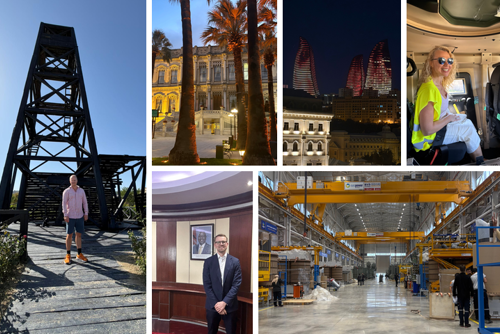
If you heard that the world’s most modern oil refinery, which is expected to become the world’s largest within three years, you would probably assume that it is located in China or India, or perhaps another large emerging market. Africa would likely not rank highly on the list of guesses, and even less so, a frontier market such as Nigeria. However, the Dangote Refinery, located outside Lagos, Nigeria’s largest city, is exactly what is being referenced. It was also one of the sites visited by the East Capital Global Frontier Markets team during our recent trip to Nigeria.
Nigeria has been on a recovery path since the election of President Bola Ahmed Tinubu in 2023. President Tinubu has implemented reforms across large parts of the economy, removing fuel subsidies that had consumed a disproportionate share of the federal budget and rebuilding the central bank, which was previously seen as both corrupt and ineffective. The results have been encouraging, with inflation declining from a peak of over 30% to the midteens. Oil production is gradually increasing, supported by a reformed legislative framework that is enabling domestic producers to expand their onshore production. The authorities are also beginning to address the long-standing issue of oil leakage, namely theft from the pipeline system. Meanwhile, international oil companies that have largely exited onshore operations are increasing investment in offshore production.
The national oil company, NNPC, has set itself the ambitious target of increasing production to 3 million barrels per day (bpd) by 2030, which would effectively double current levels. While this target may not be fully realised, it nevertheless signals the country’s direction.
One significant factor behind Nigeria’s improved outlook has been the opening of the Dangote Refinery in 2024. The USD 20 billion project, developed by Africa’s richest man, Aliko Dangote, has transformed a swamp located approximately one hour from Lagos into one of the world’s largest refineries. The facility is currently operating at 101% of its nameplate capacity of 650 kbpd, and output is expected to rise to 700 kbpd later this year. The company recently finalised a USD 10 billion investment to duplicate the existing plant on the same site, with operations targeted to begin within an ambitious three-year timeframe.
The result would be the world’s largest single-site refinery, with a capacity of 1.4 million bpd, surpassing India’s Jamnagar refinery, which has a capacity of 1.24 million bpd. An IPO of the refinery is expected later this year, supported by a favourable operational environment and significantly higher refinery margins amid ongoing volatility in the global energy market.
When talking oil refineries, health benefits are not always top of mind but replacing imports of low-quality refined products with domestically refined fuel that meets the highest EU and US standards would clearly benefit both Nigeria’s environment and population. Air pollution remains a severe issue in the country, contributing to hundreds of thousands of deaths each year.
Import substitution has also helped to reduce the previously counterintuitive and costly situation in which Nigeria exported crude oil while importing more expensive refined products derived from its own crude. This has resulted in a lower import bill and rising exports in the current account, thereby supporting foreign exchange reserves. It has also led to the disappearance of long queues for fuel that were previously common at petrol stations across the country, as the Dangote refinery can now meet domestic demand.
Plans to expand the refinery are expected to boost exports and help establish a petrochemical industry, which could create a manufacturing hub similar to Jebel Ali in Dubai. The refinery is expected to produce a range of basic industrial materials that could support broader industrial development.
Meetings with companies across sectors, including banking, oil and gas, cement, telecommunications and consumer goods, highlighted that Nigeria is in the middle of a reform-driven macroeconomic improvement. However, the benefits have yet to reach the broader population. The purchasing power of the average consumer has been under pressure for years due to high inflation and repeated currency devaluations, and meaningful improvement remains limited.
The next election, scheduled for February 2027, is widely expected to result in a comfortable victory for the incumbent President Tinubu, who is 74 years old, barring any health-related issues. A renewed mandate would likely ensure the continuity of the reform agenda that has contributed to GDP growth exceeding 4% this year, which represents a clear improvement but remains below potential. Tinubu’s policies have also led to an appreciating currency and inflation that has roughly halved from peak levels, even if it remains too high at around 15%.
The hope is that the progress achieved in recent years will eventually translate into improved living standards and help lift more Nigerians out of poverty, which still affects over 60%
of the population.
East Capital Global Frontier Markets has held positions in Nigeria’s two leading banks, Guaranty Trust Bank and Zenith Bank, since mid-2024, when clearer signs of macroeconomic stabilisation and an improving trajectory began to emerge. Since then, the banks have delivered returns of 270% and 295% respectively in local currency terms, and even stronger returns in USD terms, given the Nigerian naira’s appreciation of around 10% during the same period.
Both banks have started 2026 strongly, with Guaranty Trust and Zenith Bank rising by 75% and 130%, respectively. Based on our observations from the Lagos trip, we expect Nigeria to remain an important contributor to the performance of our East Capital Global Frontier Markets strategy.

Documents & links
Related articles