Following a very strong first half, both emerging and frontier markets were broadly flat in Q3, returning –0.4% and -0.3% respectively. July was certainly the most notable month, as we saw a rapid-deleveraging of the AI capex trade across the world. However, markets held up reasonably well, with Taiwan and Nasdaq currently refreshing all-time-highs. As such, we believe it is fair to say that the AI trade has “passed its first test”.
Figure 1. Q3 2026 and year-to-date total return in USD (%)

A leverage shakeout
The most visible casualty in July was Leopold Aschenbrenner’s Situational Awareness fund, which lost around two-thirds of its public equity portfolio before being forced to sell most of it to Citadel at a discount. This deleveraging was also keenly felt in Asia, particularly in Korea, where single-stock leveraged ETFs had become increasingly popular among domestic and other Asian retail investors. At one point, these ETFs accounted for over 20% of the trading volume in SK Hynix and Samsung Electronics, with AUM totalling over USD 50 billion. The KOSPI fell by 22% in July, its steepest monthly decline since the global financial crisis, while the unwinding of margin lending contributed to sharp falls in Chinese and Taiwanese tech stocks.
While such volatility is never welcome (not least because the investment team was supposed to be on holiday), we had become increasingly concerned about rising leverage in the system. This was one of the main reasons why we took profits and significantly reduced our exposure to the AI capex theme in Q2, as we discussed in our previous letter. With much of the excessive leverage now flushed out, the market structure looks considerably healthier, with notable falls in volatility. It is worth noting that Korean regulators only stepped in after the event, suspending new single-stock leveraged ETF listings in mid-July and tripling the minimum cash deposit required to trade them from KRW 10 million to KRW 30 million, while also raising the minimum trading lot from one unit to 20.
From AI turbulence to macro pressure
With the deleveraging behind us, the market has turned its attention to global macro themes, most notably the rapid rise in US Treasury yields (Figure 2). The 10-year yield is at its highest level for almost 20 years as we write, driven by higher oil prices, Fed tightening and concerns over fiscal discipline (or the lack of it) in the US. As the global “risk-free rate”, this is clearly an alarming development that should, in theory, put pressure on valuations worldwide.
Figure 2. US 10Y treasury yield

Emerging markets have held up well nonetheless, which can be explained by two factors: continuously strong earnings momentum and falling EM yield spreads versus the US. Figure 3 shows how earnings expectations have evolved this year. At the start of 2026, the market expected around 20% earnings growth for emerging markets, but now expects 74%. This is consistent with what we hear on the ground. Our tech analyst, Hao, consistently reports from company meetings on just how bullish AI value chain companies remain, regardless of their recent share price performance. For the time being, at least, hyperscaler capex appears to be here to stay, despite higher yields.
Figure 3. FY2026 EPS growth expectations: EM vs DM (% YoY)

Frontier markets offer a different growth story
On the client side, the most notable trend this quarter has been a strong pick-up in interest in our frontier markets fund. Clients are increasingly viewing this fund as an attractive way to balance their AI exposure, giving the rising concentration of this theme in both emerging and developed markets. Our initial analysis suggests that a 70:30 blend of emerging and frontier markets delivers a notably higher Sharpe ratio and lower volatility than an allocation to emerging markets alone.
With little exposure to the AI theme, frontier markets were largely unaffected by the July turbulence, and our fund returned 4.5% against a benchmark that fell 0.3%.
Africa continues to deliver
As in the first half of the year, Africa was the strongest contributor, led by Kenya and Nigeria. In Kenya, banks were standout performers following an exceptionally strong reporting season: Equity Group gained 34% and KCB Group 22%, with both delivering loan and deposit growth comfortably ahead of management guidance. Even after this rally, the two banks are trading at just 4.5x and 3.9x 2026e earnings, and at 1.0x and 0.75x book value, while generating returns on equity above 20% and offering dividend yields of 6-7%.
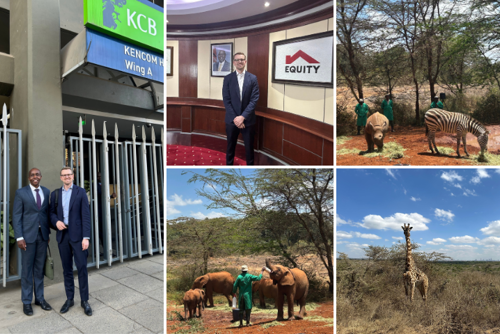
Our research trip to Nairobi towards the end of the quarter reinforced our constructive view on Kenya. Meetings with listed companies, the IMF and the National Treasury pointed to a resilient economy and a notably positive mood on the ground. Foreign exchange reserves have improved to around seven months of import cover, providing a cushion against higher fuel prices. Meanwhile, private-sector credit has fallen from around 40% of GDP a decade ago to roughly 30%, leaving considerable room for renewed lending growth.

Our visit also coincided with preparations for the groundbreaking of USD 16-17 billion Dangote-backed East Africa Oil Refinery project in Lamu, which, if executed, would broadly replicate the model of the Lagos refinery we discussed last quarter.
In Nigeria, Zenith Bank rose 26% and Guaranty Trust rose 11%. Both remain inexpensive, trading at 4-5x 2026e earnings, with returns on equity of 25-28% and dividend yields above 10%. Sentiment was further supported by a 350-basis-point cut in the policy rate to 23%, Nigeria’s return to FTSE Russell’s Frontier Market classification and the launch of Dangote Petroleum Refinery’s IPO, which is targeting around USD 1.6 billion at a valuation of roughly USD 48 billion. The largest IPO in African history. Outside of Africa, our Georgian banks continued to perform well, with Lion Finance Group up 24%, while TBC Bank increased by 18%. Meanwhile, Halyk Bank in Kazakhstan gained 21%, and it still trades at only around 1.0x 2026 book value with a dividend yield of approximately 11%.
Eastern Europe broadens the opportunity set
In Eastern Europe, Greece was the main driver of performance, particularly the banks, which were supported by ECB rate hikes and sustained loan growth. Our top pick, Optima Bank, was up 41%, while Piraeus and Alpha Bank increased by 17% and 18% respectively. We materially increased our Greek allocation during the quarter, as we see the planned MSCI developed market upgrade in May 2027 as an important catalyst. Our largest allocation, Poland, also performed well, with the economy growing by 3.9% year on year in the second quarter, and banks such as PKO and Pekao benefiting from double-digit loan growth.
The key portfolio change across our Eastern European fund portfolio was a rotation into regional refiners, with new positions in Motor Oil Hellas, Tüpraş and MOL alongside an increased position in Orlen. Light and middle distillate cracks were 3-4x higher year on year in August, and we expect Motor Oil to deliver 78% EBITDA and earnings growth in 2026, with Tüpraş earnings growing by around 105%. Persistent geopolitical tensions, underinvestment in supply and energy security priorities should maintain a supportive environment, even if taxation remains a risk. In our New Europe fund, we also built a new position in CSG, the Czech defence group, following a site visit to its military truck and land warfare operations site.

Turkey: tight policy and market stress
The situation in Turkey was more problematic. Although disinflation is ongoing, with annual inflation easing to 31.5% in August, tight policy is weighing on domestic demand. A crisis in the local investment fund sector in September, during which the regulator placed some funds into liquidation, pushed the BIST 100 into bear-market territory. We further reduced our Turkish exposure during the quarter.
A constructive outlook
Looking ahead, it is positive that the AI theme has passed its first major test, and that emerging markets are generally holding up well despite a tricky macro backdrop. However, we expect global macroeconomic factors to continue to drive markets in the near term, with investors remaining myopically focused on US Treasury yields and commodity prices. Any improvement on either front would be very well received, as valuations remain appealing. SK Hynix, for example, has announced a KRW 40 trillion share buyback, equivalent to 1% of the company’s shares per month for three months. The company also plans to return over 50% of its free cash flow over the coming years, which suggests a double-digit all-in yield for next year. On the AI side, the Anthropic IPO is likely to remain in focus, although this is unlikely to happen until after the US midterm elections in early November. Reports of USD 518 billion of contracted spending on AI infrastructure over the next decade serve as a reminder that AI remains heavily reliant on physical expansion, the benefits of which will continue to flow to Taiwan and Korea. That said, we remain fairly defensively positioned, exercising careful control over our factor exposures, including AI capex.
We are seeing greater-than-usual investor interest in frontier markets as global equity portfolios become increasingly concentrated in a small number of companies and themes. Frontier markets offer a differentiated source of growth, driven by domestic earnings and structural trends such as financial deepening, formalisation, urbanisation and rising consumption all with low correlations between individual markets. Following strong performance this year and over the past three years, we remain mindful that markets rarely move in a straight line, and rather than extrapolating recent returns, we continue to focus on our existing holdings and on identifying new opportunities.
In Eastern Europe, our outlook remains optimistic, albeit selective. We believe that an end to the Russia-Ukraine conflict would further reduce risk premiums and yields across the region. Meanwhile, longer-term themes such as EU-funded investment, energy security, financial deepening and consumer resilience continue to create attractive opportunities. We remain focused on companies where earnings momentum, valuation and balance-sheet strength have not yet been fully reflected in market expectations.
Performance in USD net of fees.
This is marketing communication. This publication is not directed at you if we are prohibited by any law in any jurisdiction from making this information available to you and is not intended for any use that would be contrary to local laws or regulations. Every effort has been made to ensure the accuracy of the information, but it may be based on unaudited or unverified figures or sources. The information in this document should not be considered investment advice and should not be used as the sole basis for an investment decision. Please read the Prospectus and the KID, which are available on the fund pages at www.eastcapital.com