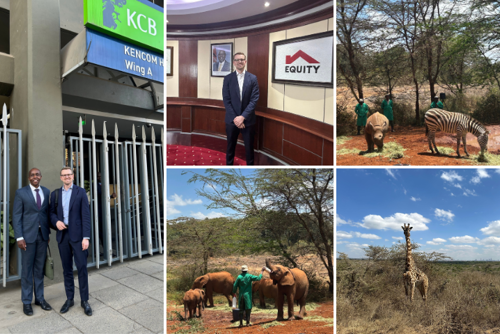
For most people, Kenya is synonymous with safari, and anyone with a spare day in Nairobi should take the chance, as Nairobi National Park lies right on the edge of the city. A word of warning, though: keep clear of the baboons. They show no hesitation in jumping into the car to steal your food, as we found out when one made off with our breakfast through the open roof. Most of the trip, though, was spent in meeting rooms rather than on game drives.
Kenya has, following Nigeria, been the strongest contributor to the performance of East Capital Global Frontier Markets this year, with Kenyan equities up more than 30% and Nigerian equities more than 70% in USD terms year to date. During three full days in Nairobi, we met eight listed companies, the IMF and the National Treasury, and visited a Safaricom flagship store at the Westgate Shopping Mall. The picture that emerged was one of an economy on steadier footing, with strong banks and a deepening domestic capital market, but with fiscal homework still to do.
A more stable economy, but fiscal challenges remain
In our May note from Lagos, we described how the Dangote Refinery has transformed Nigeria’s fuel market and current account. During our Nairobi trip, Nigerian industrialist Aliko Dangote held the groundbreaking ceremony for a refinery of similar scale in Kenya, an investment estimated at USD 17 billion, or roughly 13% of the country’s GDP. Unsurprisingly, it was the most talked-about topic in Nairobi. The refinery could have a major long-term impact on Kenya and the wider region, although it is still early days, with construction estimated to take around 40 months.
Kenya’s GDP growth reached 5.3% in the first quarter of 2026, and the Treasury expects growth of around 5% for the full year, helped by a recovery in construction. Inflation has risen from around 3–4% due to higher oil prices and other external pressures, but at 6.6% it remains within the central bank’s target band. The shilling has been broadly stable against the US dollar for almost two years, and foreign exchange reserves have been rebuilt to around six to seven months of import cover, up from four months or less a few years ago.
Public finances remain the main area to watch. The budget deficit reached 6.8% of GDP, above the original target,, and with a general election due in August 2027, appetite for new taxes is limited. The Treasury is responding with tighter spending controls, digital procurement and efforts to widen the tax base. It is also moving infrastructure projects off the budget into a new National Infrastructure Fund, seeded with privatisation proceeds. Talks on a new IMF programme have started, but an agreement before the election looks unlikely.
Banks well positioned as credit growth recovers
The banking sector, by contrast, is in good health. Private-sector credit growth has picked up to around 10%, from about 2.5% in 2025. Non-performing loans remain high by international standards, but they are falling as the government clears overdue payments to contractors, and the cost of risk has come down considerably. Minimum capital requirements for banks are rising tenfold, which is likely to trigger consolidation among smaller lenders and benefit the large, well-capitalised banks.
East Capital Global Frontier Markets holds Kenya’s two largest banks, KCB Group and Equity Group, which have returned 51% and 70% respectively in USD so far this year and more than doubled since we first invested in July 2025.. Both are well capitalised and, like most Kenyan banks, hold a large share of their balance sheets in government bonds. As credit demand recovers, both banks plan to shift some of these assets towards lending, which should support margins and fee income. Both also see the Dangote refinery as a sizeable lending opportunity.
Equity Group’s loan growth is running ahead of full-year guidance, and there is plenty of room left: only about 1.2 million of its 23 million account holders currently borrow. Meanwhile, its DRC subsidiary, which accounts for around a third of the group balance sheet, is steadily improving its returns.
At KCB, asset quality is improving as government arrears are paid and legacy exposures are written off. With strong capital, KCB also plans to raise its dividend payout ratio from around 35% to 50% over the next three to four years. Even after the strong run, valuations remain undemanding: Equity trades at around 4x expected 2027 earnings and KCB at 3.5x, with dividend yields of around 7% and 8% respectively.
Safaricom and a deepening domestic capital market
Safaricom, the third and largest of the fund’s holdings in the country, is Kenya’s leading telecom operator and the home of M-PESA, one of the world’s most successful mobile money ecosystems. In Ethiopia, where Safaricom launched in 2022, management is confident that the business will reach its EBITDA breakeven target this financial year. Meanwhile, its core Kenyan operations remain very strong, with Safaricom Kenya generating an EBITDA margin of almost 57% in the last financial year and continuing to add close to 3 million subscribers. The shares have returned 34% in USD so far this year and trade at around 10.5x expected 2027 earnings, with a dividend yield of around 7.5%.
Safaricom is also helping to deepen Kenya’s capital market. Its Ziidi Trader service, which lets M-PESA users trade shares from their phones, already accounts for around 3% of traded value on the Nairobi Securities Exchange. Pension funds are steadily raising their equity allocations as well. Together, these trends are building a stronger domestic investor base at a time when foreign portfolio ownership of Kenyan equities has fallen to low levels.
From stabilisation to growth
Kenya is entering an increasingly interesting phase. The currency has stabilised, foreign exchange reserves have been rebuilt, credit growth is recovering and the banking system remains well capitalised. At the same time, large-scale private investment, including the planned Dangote refinery, could add another important leg to the country’s growth story.
For equity investors like us, this improving backdrop is being reinforced by strong company fundamentals, attractive valuations and a gradually deepening domestic capital market. Despite the strong performance of Kenyan equities this year, we continue to see compelling opportunities in the market and believe we are well positioned to build on the gains already captured as Kenya enters its next phase of growth.

Related articles