We recently returned from a three-day investor trip to India, during which we met with senior executives of several leading companies, as well as policymakers in Mumbai and Delhi. We came away cautiously optimistic about the outlook for Indian equities. In our view, there has been a growing disparity between the excessive pessimism of foreign investors, which was reflected in the surprisingly low number of foreign attendees on the trip, and the steady improvement in economic activity that we saw first-hand.
The resilience of the Indian economy has come as a surprise
India’s growth momentum has held up well against a series of external headwinds, including US tariffs, sustained foreign portfolio outflows and the recent energy price shock stemming from the conflict in the Middle East. Well-timed fiscal and quasi-fiscal measures, as well as front-loaded monetary easing and robust credit expansion have helped insulate domestic activity. In 3Q, the net income of the Nifty 50 Index grew by 21%, exceeding consensus expectations.
The policymakers we met remain confident of achieving the fiscal deficit target of 4.3% for the current financial year (i.e. FY27), supported by the recent fall in oil prices and rising services exports (IT, business consulting, GCC, etc.) (up 9% YoY CYTD) and an increase in merchandise exports (engineering goods, electronics, pharmaceuticals, etc. up around 14% YoY CYTD). The net landed cost of crude oil has dropped from USD 110/bbl in October to USD 100/bbl. If oil were to drop to USD 80, this would provide a huge tailwind for India’s economic growth, which could exceed 8% in FY28 (compared to 7.8% in 2QCY26), while also decreasing the country’s fertiliser subsidy currently accounting for around 0.4% of GDP.
Concerns about jobless growth, a bit exaggerated
India’s IT services sector has been one of the country’s largest generators of formal jobs. The number of employees has grown at an 11% CAGR over the past 25 years, reaching roughly 3.6 million employees in traditional IT. This figure represents less than 1% of the total workforce. However, momentum has faded recently. Revenue growth has slowed to the low single digits over the past three years, with headcount rising by just 2.3% YoY in FY26, and several of the largest companies announcing layoffs. This has raised investor concerns about the sustainability of India’s growth.
While we acknowledge the slowdown in IT hiring, given that the sector employs less than 1% of the workforce, it is unlikely to define India’s broader employment trajectory alone. Other parts of the economy are also offsetting this slowdown. Manufacturing accounts for around 12% of the workforce, and employment in this sector has grown at a 6.8% CAGR over the past three years. Global Capability Centres (GCCs), the technology and operations hubs owned by multinationals companies, have increased their workforce by 11.4% CAGR over the same period. A similar trend is evident in company formation: 946000 new companies were registered between FY22 and FY26, compared with 607000 between FY17 and FY21, nearly doubling the annual rate.
More importantly, the policymakers we met were very optimistic the potential signing of three key FTA’s (Free Trade Agreements) with Canada, the EU and potentially the US in the near term (i.e. by December 2026), which could generate employment and growth opportunities labour-intensive sectors such as textiles, leather goods and marine products.
Tax incentives for foreign investors are in the pipeline
Most notably, policymakers acknowledged that sustained foreign inflows are essential to keeping India’s current account deficit below 2% of GDP in the long term, and that FIIs (Foreign Institutional Investors) need to be incentivised to invest in India again. Along with recent media comments made by the Finance Minister on long-term capital gains (LTCG) tax, we now consider it more likely that a capital gains tax concession will be granted to FIIs in the Union Budget in February 2027. If the incentive is credible, we would expect a meaningful reversal in foreign flows, which currently stand at around USD 30 billion YTD through October.

A potential inflection point in growth and sentiment
India has underperformed the MSCI EM index significantly over the past two years. A high starting point on valuations, a global shift towards AI and weak FII sentiment have driven record cumulative foreign outflows of USD 64 billion between September 2024 and October 2026. However, we firmly believe that the worst is now behind us and that Indian equities may be approaching an inflection point, for the following reasons:
1) Corporate earnings momentum has been gaining momentum over the last four-five quarters, despite rising oil prices, and has reached a three-year high of 21% YoY in 3Q CY26 (see Figure 1). Earnings have beaten consensus estimates for five consecutive quarters, with the magnitude of the beats widening over the last three. Even so, we believe that this earnings momentum can continue as domestic demand has broadened beyond the end consumer to the capex-sensitive midstream and upstream layers of the economy. Real estate, industrials and utilities are all now delivering revenue growth of around 20%, the first time in several years that this has happened simultaneously. Corporate commentary on demand strength has also improved markedly, reaching a five-year high and outweighing concerns on costs.
Figure 1. MSCI India earnings growth (% YoY)

2) A decline in oil prices could improve corporate profitability and rachet up sentiment. Following the US midterm elections, we see a higher probability of a quick resolution to the Iran-US conflict, with President Trump stating that “more strikes on Iran are unlikely”, which could lead to a sharp decline in crude oil prices. This, in turn, is expected to ease input cost pressures and, more importantly, improve foreign sentiment towards India (Brent crude declined by 16% and MSCI India rose by 9.3%, over the last 1 month).
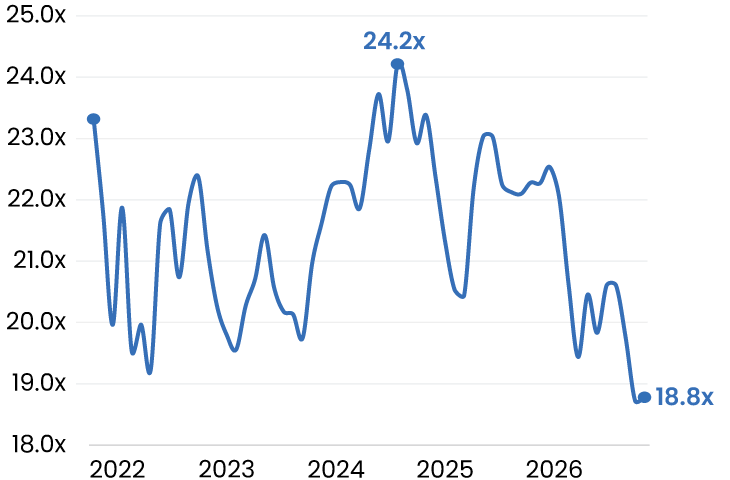
3) Attractive valuations: MSCI India has fallen sharply from its 2024 peak to a five-year low of around 19x forward earnings (see Figure 2). We do not expect it to return to the previous peak of around 24x. However, accelerating growth, continued earnings surprises, lower oil prices and the need for investors to diversify away from the AI trade should give FIIs good reason to reduce their underweight position in India, which Goldman Sachs estimates to be around 190 bps. Early signs of this shift are already visible. Over the last 30 days, India has outperformed the MSCI EM Index by 23.9%, attracting approximately USD 13 billion of foreign inflows. We see these as early indications of a potential trend reversal and anticipate that the momentum will build from here.
Figure 2. MSCI India, 12-month forward P/E (x)
Positioning
Over the past eight months, our positioning has been relatively conservative, focusing on high-quality large caps and a few small caps with predictable cash flows. Recently, we have begun gradually adding to high-quality names that we believe have been excessively punished. One example is MakeMyTrip (MMYT), which is down 38% YTD and trades at a five-year low valuation of 24x P/E FY1. MMYT remains India’s dominant online travel platform, with around a 40% share of monthly active users among Indian online travel apps. More importantly, despite the decline in air traffic, MMYT delivered 20% gross booking value (GBV) growth in the first half of FY27 and beat expectations. This was driven by steady growth in hotels (+20% YoY) and buses (+30% YoY), where domestic travel demand has held up despite the decline in air passengers. As the decline in air traffic volumes begins to ease, we expect MMYT’s earnings momentum to accelerate.


Related articles